
How to Find a Reliable Toner Cartridge Factory in China: A 2026 B2B Buyer’s Guide
1. Identify “True” Manufacturers vs. Trading Companies
The first hurdle is distinguishing between a factory and a middleman. While some trading companies offer excellent service, a direct factory provides better pricing control, faster technical support, and consistent quality.
- Check the Business License: Ask for a copy of their Chinese business license. Look for the “Business Scope”. A true factory will include terms like “Manufacturing” or “Production”, whereas a trading company will only list “Sales” or “Consulting”.
- Location Matters: Most top-tier toner factories are concentrated in Zhuhai (the “World Capital of Printing Consumables”) or Zhongshan/Shenzhen/Dongguan. If a factory is located in a city with no imaging industry cluster, they may be outsourcing.
2. Verify Technical Expertise and R&D Capability
In 2026, a toner cartridge is no longer just a plastic box; it’s a high-tech device.
- The Chip Solution: HP, Brother, and Ricoh frequently update firmware to block compatibles. Ask the factory: “Do you have an in-house chip R&D team, or whose chip solution do you use?” A reliable factory will have partnerships with top chip manufacturers (like Apex or Geehy) or their own engineers.
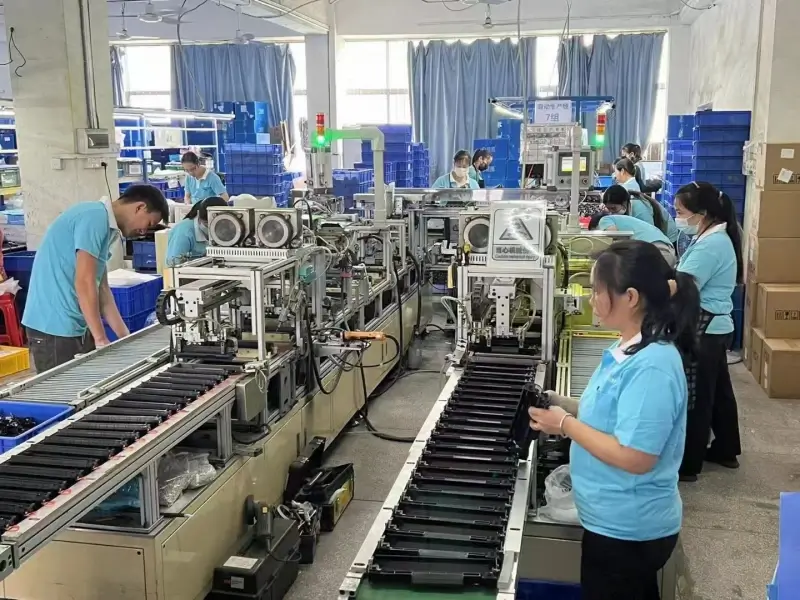
- Automated Production: High-quality factories have moved toward automated assembly lines. Automation reduces human error, specifically in the installation of the doctor blade and developer roller, leading to a much lower defect rate (ideally <0.5%).
3. Inspect Industry Certifications (The “Big Three”)
Don’t just take their word for it; verify their certificates on the official issuing bodies’ websites.
- ISO 9001 & 14001: These are the baseline for quality and environmental management.
- STMC (Standardized Test Methods Committee): This is the gold standard in the imaging industry. STMC certification proves the factory uses standardized methods to test page yield and image density.
- Compliance (REACH, RoHS, CE): If you are selling in Europe or North America, these are non-negotiable. Ensure the factory can provide legitimate lab reports for their materials.
4. Evaluate the Quality Control (QC) Process
A reliable partner will be transparent about their failures. Ask them to describe their QC workflow:
- Incoming Inspection (IQC): How do they test the toner powder and OPC drums before assembly?
- Environmental Testing: Do they put cartridges in high-temperature/high-humidity chambers to simulate shipping across the ocean?
- Post-Production Test: A premium factory performs a 100% post-test (printing a test page with every single cartridge) before it leaves the line.
5. Request a “Virtual Factory Tour” or Third-Party Audit
If you cannot travel to China, use technology to bridge the gap:
- Live Video Call: Ask for a walk-through of the production floor via WeChat or Zoom. Pay attention to the cleanliness (dust is the enemy of toner) and the staff’s protective gear.
- Third-Party Audits: Hire services like SGS, Intertek, or QIMA to perform an on-site factory audit. For a few hundred dollars, they will provide a 20-page report on the factory’s actual capacity and quality systems.
6. Start with a “Trial Order” Strategy
Never commit to a full container (FCL) immediately.
- Phase 1 (Sample): Test 5–10 units for print density and chip compatibility.
- Phase 2 (Trial Batch): Order 100–500 units. This tests the consistency of their mass production. Look for variances between the first and last cartridge.
- Phase 3 (Partnership): Once consistency is proven, negotiate your long-term wholesale pricing and private label (OEM) packaging.
7. Communication and After-Sales Support
In the B2B world, the “Toner Cartridge Business” is actually the “Problem Solving Business.”
- Response Speed: Does the sales representative understand the technical nuances of an SC542 error code or a firmware block?
- Warranty Policy: What is their replacement policy for defectives? The industry standard is a 1:1 replacement or credit for any cartridge with a defect rate exceeding 1%.
Conclusion
Finding a reliable toner factory in China requires looking beyond the “lowest price.” Focus on technical stability, STMC certifications, and automated production. A factory that invests in its own technology is a partner that will help you survive the next printer firmware update.
Are you ready to vet your next supplier?
We are a Zhongshan-based manufacturing leader with 15+ years of experience in high-yield compatible toners.
[Contact us for our Latest Factory Audit Report] | [Request a Sample Kit]

Leave A Comment