
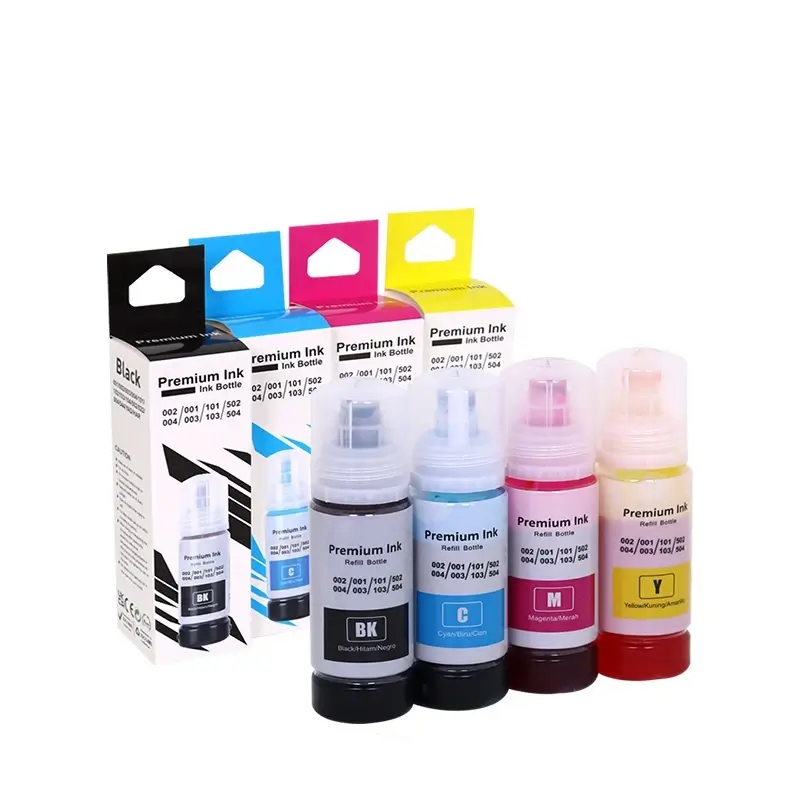
What is Sublimation Ink?
This article will discuss the characteristics, principles, and applications of sublimation ink. What is Sublimation Ink? And how does it work?
In the field of digital printing, sublimation ink, with its unique color performance and application flexibility, has become an important consumable in personalized customization, industrial production, and other scenarios. Whether it’s everyday phone case designs, sportswear prints, or professional advertising boards and home décor, sublimation ink can be relied upon to achieve high-definition, long-lasting color reproduction.
I. What is Sublimation Ink?
Sublimation ink is a special printing ink with dye as its core component. Its key characteristic lies in the “sublimation reaction”—under high temperature (typically 180-220℃) and pressure, the ink sublimates directly from a “solid” state to a “gas” state, penetrating into the fibers or molecular gaps of specific materials. Upon cooling, it re-solidifies, forming a color layer integrated with the material.
Unlike traditional inkjet inks (such as water-based and oil-based inks), sublimation inks do not form a “coating” effect on the material surface. Instead, they achieve color adhesion through “penetration and bonding,” which is the core reason for their superior texture and durability compared to other inks.
II. Core Characteristics of Sublimation Ink
-
1. Color Performance: High Saturation and Wide Color Gamut
Sublimation inks have finer dye particles that penetrate the material evenly after sublimation, resulting in richer color gradations and higher saturation. Whether it’s gradient colors, complex patterns (such as photorealistic images), or high-contrast designs, they can accurately reproduce colors, especially excelling in reproducing delicate colors such as skin tones and natural landscapes. They are widely used in photography printing, high-end decorative paintings, and other applications.
-
2. Adhesion Stability: Abrasion-resistant and Fading-resistant
Because the dye bonds directly to the material molecules (rather than adhering to the surface), sublimation printing results in products with excellent durability:
• Abrasion and Scratch Resistance: Daily friction and minor scratches do not easily cause the pattern to peel off (e.g., sports backpacks, luggage printing);
• Strong Weather Resistance: Under normal temperature and dry conditions, the colors can remain vibrant for years and are washable (requires special fabrics, such as polyester fibers), suitable for high-frequency use scenarios such as clothing and home textiles;
• Free of Harmful Substances: High-quality sublimation inks do not contain heavy metals, formaldehyde, or other harmful components, complying with EU REACH, US FDA, and other environmental standards, and can be used in children’s products and food contact packaging (e.g., customized cups).
-
3. Application Flexibility: Adaptable to Multiple Materials
Can I use sublimation ink on any printer? While sublimation ink is not a “universal” ink, it is compatible with a wide range of materials. The core requirement is that the material possesses a certain degree of thermal stability and sufficient intermolecular spacing. Common compatible materials include:
• Synthetic Fibers: Polyester (the most mainstream, such as sportswear and yoga pants), nylon, spandex, etc.
• Coated Materials: Metals with a special sublimation coating (such as insulated cups and medals), ceramics (such as mugs and tiles), glass (such as decorative paintings and mobile phone back covers), and plastics (such as toys and stationery made of ABS and PC materials);
• Special Papers: Sublimation transfer paper (used for indirect transfer, where the ink is first printed onto the paper, and then transferred to the target material through high temperature).
III. Working Principle of Sublimation Ink: A Three-Step Process of Sublimation – Penetration – Solidification
How does Sublimation Ink work?
The sublimation printing process relies on the synergy of “ink + equipment + material.” Its core principle can be broken down into three key steps, using the common “transfer printing” (printing on paper first, then transferring) as an example:
-
Step 1: Ink Printing (Digital Output)
Using a dedicated sublimation printer (mostly piezoelectric inkjet printers, such as the Epson L805 or Roland BT-12), the designed pattern (note the need for “mirror reversal” to avoid the pattern being reversed after transfer) is printed onto sublimation transfer paper. At this point, the ink adheres to the paper surface in liquid form, forming a preliminary pattern.
-
Step 2: High-Temperature Sublimation (Core Reaction)
The transfer paper with the printed pattern is adhered to the target material and placed in a heat transfer machine (select the equipment according to the material, such as a flatbed heat press, roller heat press, or mug press). The appropriate temperature (180-220℃), pressure (3-8 kg/cm²), and time (10-60 seconds, adjusted according to material thickness) are set. Under high temperature, the ink dye on the transfer paper skips the liquid state and sublimates directly into a gaseous state, detaching from the paper and diffusing onto the surface of the target material.
-
Step 3: Penetration and Solidification (Color Fixation)
The gaseous dye penetrates into the molecular gaps of the target material (such as the interfiber gaps of polyester fibers or the pores of the coating material). At this point, the heat transfer machine is turned off, the temperature drops rapidly, and the gaseous dye re-solidifies into a solid state, tightly binding with the material molecules, ultimately forming a firm, uncoated pattern.
IV. Advantages and Disadvantages of Dye Sublimation Ink: Applicable Scenarios and Precautions
-
1. Core Advantages
• Delicate Texture: No surface coating, no “glue-like” feel to the touch, especially suitable for clothing, fabrics, and other materials that come into contact with the skin;
• Suitable for both batch and customization: Supports small-batch personalized customization (e.g., a single customized mug, a single T-shirt), and can also achieve mass production using industrial-grade equipment (e.g., garment factories, gift processing factories);
• High Pattern Precision: Resolution can reach over 1440 dpi, capable of reproducing fine lines (e.g., text, logos) and complex images (e.g., photographs), without jagged edges or blurriness.
-
2. What are the disadvantages of sublimation printing? Limitations and Precautions
• Material Restrictions: Cannot be directly used on pure cotton, wood, uncoated metal, etc. (Pure cotton requires pre-coating, otherwise the dye cannot adhere);
• Equipment Requirements: Requires a dedicated dye-sublimation printer and heat transfer machine; initial equipment investment is higher than traditional inkjet printing;
• High Storage Requirements: Ink must be stored in a sealed container in a cool, dry place (avoid direct sunlight and temperatures below 30℃). Use as soon as possible after opening to prevent printhead clogging and color deviation;
• High Temperature Dependence: The printing process requires high temperatures; equipment safety must be ensured. Some heat-sensitive materials (such as ordinary plastics and thin paper) are not compatible.
V. Recommendations for Purchasing and Using Dye Sublimation Ink
-
1. Purchasing: Focus on “Compatibility” and “Quality”
• Match Printer Model: Different printer brands use different printhead technologies (e.g., Epson printheads require “mild solvent-based dye sublimation ink” to avoid printhead corrosion). Choose ink compatible with your printer (prioritize original manufacturer or third-party certified brands);
• Check Environmental Certifications: If used in children’s products or food contact materials, confirm that the ink has passed SGS, FDA, and other environmental testing to avoid harmful components;
• Choose the Size as Needed: For small-batch use, 100ml/500ml bottles are suitable; for large-scale production, 1L/5L containers are recommended to reduce costs.
-
2. Usage: Avoiding Common Problems
• Regular Equipment Maintenance: When the printer is not used for extended periods, print a “test page” weekly to prevent ink from drying and clogging the printhead.
• Precise Parameter Control: Temperature, pressure, and time need repeated adjustments for different materials (e.g., 190℃, 15 seconds for polyester clothing; 200℃, 30 seconds for ceramic cups) to avoid material deformation due to excessive heat or blurry patterns due to insufficient temperature.
• Pattern Pre-processing: Use CMYK color mode when designing patterns (dye sublimation inks are mostly CMYK four-color, some containing white ink) to avoid color deviation caused by using RGB mode; also, for dark materials, print a white background first, then print the colored pattern to improve color saturation.
VI. What is sublimation ink used for? Expanding Application Scenarios of Dye-Sublimation Ink
With technological upgrades, the applications of dye-sublimation ink have expanded from the traditional “gift customization” to more fields:
• Apparel and Textiles: Personalized jerseys for sports brands, limited-edition hoodies for trendy brands, and customized bed sheets in the home textile industry (requires polyester fiber fabric);
• Home Decoration: Tile background walls, glass decorative paintings, and wood grain transfer (requires pre-coating treatment);
• Industrial Manufacturing: Electronic product casings (such as headphone and laptop cases), and automotive interiors (such as seat printing and center console decoration);
• Cultural and Creative Products: Pattern printing for blind box figurines and gold foil effects for book covers (replacing traditional gold foil processes, reducing costs).
In the future, with increasing environmental protection requirements and breakthroughs in material coating technology, dye-sublimation ink is expected to achieve more innovations in areas such as “biodegradable material printing” and “flexible electronic tags,” further expanding its application boundaries.

Leave A Comment